Posts Tagged ‘Bells and Clocks’
Centrally Manage Your School Bell Schedules with InformaCast
When you need to set the clocks and bell schedules in your school, do it from a simple web portal.
Here’s how it works.
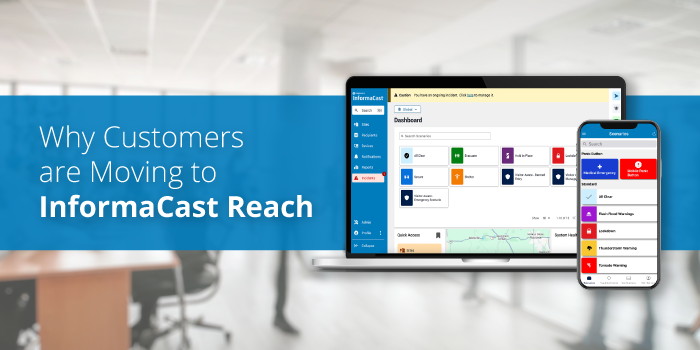
After logging into InformaCast, school administrators can add, delete or modify bell schedules for all the schools in the district. With the click of a button, the changes can be implemented.
Logging onto InformaCast via a secure web portal, a school administrator can quickly add, delete or modify the bell schedules for the entire school district and instantly apply the changes.
For daylight savings time bell schedule changes, the InformaCast server automatically recognizes the time change and updates each of your bell schedules for all of your schools.
Use Singlewire InformaCast to centrally manage the clocks and bell schedules in your school.
Learn more about our solution by visiting singlewire.com/k-12.
Managing School Bells with Singlewire InformaCast
One minute video. When there’s a change in your class schedule, make modifications to your bells with the click of a button. Save time and money by using Singlewire InformaCast to manage the bell schedules in your school.
Podcast – Using InformaCast with Legacy Analog Paging Systems – LPI
Podcast: Play in new window | Download (Duration: 7:31 — 5.2MB)
Learn how the Legacy Paging Interface or LPI from Singlewire Software can be used to connect InformaCast to legacy analog paging systems.
Transcript
INTERVIEWER: We’re talking with Ken Bywaters, Executive Vice President of Product Management. Ken, can you talk to us about the LPI or Legacy Paging Interface? What is this and what does it do?
KEN: Sure, so the LPI, you know, maybe we didn’t name it that, all that glamorous but this is what it does. For people with an existing paging system, an analog paging system, but that also have Cisco phones and desktops we’re using InformaCast to talk to those things, you want to be able to talk to your existing speakers as well. And there’s several ways to do this, but a fairly recent one, at least starting in Fall 2009 was the LPI. And the LPI is software. It’s separate from InformaCast and it allows you to connect InformaCast or ControlKom, for that matter to your existing paging system through software
And the key differences are, it’s a very clean set-up. So you can set up the LPI and have it connect to your existing paging system through an fxo or fxs port on your router. Any analog connection from CallManager to your paging system, we can take advantage of.
And beyond that we can also send zone information to that paging system. So a lot of the existing paging systems are zoned, I think they’re four zones or eight zones, and you use keys on your phone, DTMF maps to select which zone you’re talking to.
Within the LPI you can set all of that up. So we mimic all the zones so that you can just say, “Well, Zone 1 is this and Zone 2 is this. You know, East Wing, West Wing”, whatever. And then within InformaCast it all shows up as, you name it. East Wing of Building 1, West Wing of Building 1, things like that. And this way you don’t have to go to your phone and hit pound-1 to talk to that zone. You can send an InformaCast message, we connect to that zone and that paging system as well as send the message out to Cisco phones and desk tops and high beam speakers like we’ve always done.
And the way we’ve done it is, it’s synchronous so you don’t, it’s not two separate messages. We actually place a phone call to that existing paging system and stream the audio to it at the same time we stream the audio out to all of the devices on the IP network.
INTERVIEWER: This sounds like a great solution for an organization, a school, or a business that may be in an older facility but yet, want some of the modern conveniences or abilities of InformaCast. Is that where you’re seeing this go into?
KEN: Yeah, it’s going into almost every market that we serve but your example of schools is a good one. So a K-12 district, let’s just take a typical one. Let’s say they have 20 schools in the district. It’s a good bet that they’ve got multiple manufacturers of analog paging systems in those 20 schools. They might have three or four different manufacturers scattered around those 20 schools.
And no way to centrally manage their bell schedules, no way to get a message out, district-wide, or anything like that. With InformaCast and the LPI, you can bring all of those 20 schools online on the IP network using the LPI and then you centrally use InformaCast to manage all of your bell schedules or do a district-wide announcement.
So, for not very much money per school, you can immediately get district-wide notification and central bell management without any hardware or architectural changes. And that’s what’s difficult for schools. To change an existing paging system usually means changing the rack of equipment that was built many years ago or slopping other things in or running new cable. You don’t have to do any of those things. You can just do it all on software and get all the benefits that you would, if you built all new schools with all new cabling and IP speakers. Just use your existing infrastructure to get those benefits.
INTERVIEWER: So I’m assuming then, too, once a new facility would come online or be built, it’s just as easy then to wire that with Cat-5 and have a regular network-type installation and keep the functionality all in place. Is that the case?
KEN: Yep. People mix and match all the time. And it’s obviously completely cost-driven. In a new building, the cost of running copper wire through conduits and putting power supplies and amplifiers all in that network for dedicated analog paging system can actually end up being a lot more than just running simple Cat-5 to IP speakers.
So if you do have new construction mixed in with your existing buildings, your existing paging system, it’s easy to mix and match. And InformaCast doesn’t care. It looks all the same, to us.
INTERVIEWER: Now if I’m a school administrator or a building facility manager listening to this, what do I need to know? I mean, is this a proven technology? Is this something that can work and is working in existing buildings now?
KEN: Oh yeah, it’s working at many, many places. So, if you’re a facility manager, most people in that role are burdened with making changes to the system, knowing lots of different systems. You can have it, in K-12 in particular, if you have a, let’s say, a two hour delay, having to go to that school and make the change to that system, that can be very time consuming and burdensome.
So, again with this, with InformaCast and the LPI, you can centrally manage all of that. And it’s a very clean and very simple way to connect to your existing paging system. So you don’t have to do it, or what’s very common, you don’t have to pay another company to drive out and do it.
I’ve had a lot of customers who’ve said before we put this in, any time we made a change to our analog paging system, it cost us a minimum of $600, for every change.
So, with the LPI it was very clean and simple and now they can zone things or make broadcasts or do anything they want themselves. And it’s very simple to do.
INTERVIEWER: Now we have some materials on our website. What is, what’s a typical route for one to learn more about this solution?
KEN: Probably the best route is to contact your Singlewire salesperson. Or contact Singlewire sales in general. We can get you all the information, any documentation, including the product to try out. Most of the time people have questions about the specific paging system they have, but the way we’ve implemented it, it doesn’t matter to us what kind of system you have. We just add a very simple analog connection to it, so a lot of choices.
INTERVIEWER: Very good. Thank you, Ken, for your time.
KEN: Thank you.
Saved by the Bell – Large California School District Implements InformaCast
One of California’s largest school districts chose an IP telecom system to boost its schools’ safety, but discovered many other benefits.
Appearing in EdTech K-12
Story by Julie Sturgeon, Photo by Max S Gerber
As principal at Chaparral High School, Lucia Washburn no longer dreads lockdowns.
Each year, the Grossmont Union High School District requires each facility to conduct two such emergency drills. Officials sound a special alarm, and students must get to the nearest room that has a door or that locks. Teachers practice keeping students safe in that secure space, and the El Cajon police officers check every room to make sure the campus is secure. The entire process lasts an average of 10 minutes — but for Washburn, it was 10 minutes of frustration because her building had no public address system. Instead, she communicated with teachers over telephone speakers.
“If the class was a bit loud, they couldn’t hear anything,” she notes.
In the fall of 2005, Jack Blaylock, director of technical services at this San Diego, Calif.-area district, selected Chaparral to investigate a new IP telecom system under consideration. Singlewire (formerly Berbee) billed its InformaCast product as a robust, full-featured system that allows users to simultaneously push an audio stream and/or a text message to multiple Internet Protocol phones and speakers. The Madison, Wis., manufacturer originally built the system for the Department of Commerce after personnel there found themselves banging on doors on 9/11 in an effort to evacuate a building without loudspeakers.
Of course, Blaylock wasn’t willing to invest in new switches, speakers and software for one building; he had a bigger challenge on his hands. The 19 campuses in this high school district handed him a mixed bag of four or five different notification systems. “Some of it, I don’t know if there’s a brand name on it because it goes back 50 years [to] when the school was built,” he says.
The variety alone meant a lot of downtime for the maintenance department as it struggled to stock the right parts to keep each independent intercom system, bell scheme and clock working. And then it was nearly impossible to keep any two clocks within a high school in sync with each other — one class would pack up early waiting on the bell while another was caught by surprise. “They were all in really bad shape, so it was the prime time to catch up with the standards,” Blaylock reports. “IP basically rolled all three areas into one.”
Today, the announcement system is an enterprise that allows users to contact any combination of schools simultaneously. Because each intercom carries an IP address, officials narrow their message as specifically as the math department at one, two, three or all the high schools.
“Anyone with the code can make an emergency broadcast from any telephone in the school,” Blaylock notes. Users can also send a text-only update flagged by an unobtrusive audible alert, so administrators can sidestep starting a schoolwide panic over the speakers, says Ken Bywaters, director of voice products at Singlewire.
IP Telecom Made Sense
Grossmont Union High School District began converting to an IP structure in 2000, starting with phones and then adding security cameras. Because Blaylock built the network using Optical Carrier OS3s between the school and his servers, bandwidth wasn’t an issue. “It made it very easy, when a product like this came along, to put it on our network,” he says. “We didn’t have to go out and buy a bunch of equipment and make a drastic change. It was just a matter of adding more ports.”
The district also had another advantage already in place. Back in 1990, administrators ran fiber underground between the buildings to avoid shutting down entire campuses in case of lightning strikes, electrical surges and other problems. It has enhanced the infrastructure over time, running new fibers for faster speed on the data network, and reducing as many as 10 conduits to four.
Still, architects working on building renovations relied on yesterday’s features from names they already knew — Dukane, Rauland-Borg — to create the bid specifications. They were solid products, Blaylock knew from his research, but in the end the district would wind up paying for duplicate features using that route. For instance, the IP phones covered the same needs as a two-way intercom system did.
“And you still had to go to the local call box and have wires run to the cabinet,” he says. Those wires usually ran along the roof, where Mother Nature rotted away the elements. Blaylock estimates that 30 percent to 40 percent of the analog speakers in some of his schools no longer work.
So what Singlewire suggested was tempting, “but it was new,” he adds. “What if it doesn’t do everything it says it will? What’s the turnaround on parts if something breaks? How quickly can we get service to it here on the West Coast?” played like a drumbeat in his head. He called a colleague at Rialto (Calif.) Unified School District whom he knew through the California Educational Technology Professional Association for a heart-to-heart conversation on the district’s satisfaction with InformaCast, and decided it was at least worth a pilot test at Chaparral.
The system’s cost was an issue for Blaylock. “The speakers were more expensive than I’m used to paying. But even when you took that price and the licensing fees and add it all together versus the infrastructure costs to go with the traditional system, I was out in front. Once we had some of those numbers put together, it started making more and more sense.”
Testing … One, Two, Three
On the other hand, Grossmont Union did need to make a few up-front network investments. True, the district already enjoyed Optical Carrier 3s’ 155-megabits-per-second lines running between the school campuses and Blaylock’s department at the district’s headquarters. But because it built its IP network more than five years ago, it met 5e standards that have changed when it comes to switching for Power Over Ethernet. In a nutshell, Blaylock needed to purchase one new Cisco switch to run power ports to the equipment. Happily, the InformaCast system needs no electrical plug because it is fed right from the data switch.
The initial installation was a no-brainer. The district had two possibilities to choose from: set a server at the site or run the entire operation from the district headquarters. Blaylock chose the first because “if anything happens at the office, you don’t want to take down everyone’s communication system. When you get more than 10 schools wide, you don’t want headquarters to be the weak point,” he says. So he bought an enterprise license from Berbee, set up a server at Chaparral, installed the InformaCast software, and then tied that server back to his main server.
His team spent a week getting the hardware into place and then another month fine-tuning the configurations and adjusting speaker volumes in each classroom. And after the initial configuration, the clocks suddenly quit. Turns out, the IT department assumed the settings rather than seeking the manufacturer’s recommendations, which caused a problem in the software. Thankfully, the proper configurations righted the gaffe.
Blaylock admits the next rollout should be faster now that they’ve worked out these bugs, although other high schools will offer a challenge — to amplify football fields and other outdoor areas that 350-student Chaparral High School doesn’t offer.
Since then, school administrators have made their own tweaks. They prerecorded the lockdown message so that if they’re ever in the midst of a real emergency, Washburn can activate it by pushing two phone buttons.
Police department feedback during lockdowns resulted in Chaparral posting periodic updates during the drill to give teachers a sense of what’s happening outside their darkened classrooms. During spring break in 2007, the local SWAT team used Chaparral as a training ground for its officers, and suggested school administrators run the emergency announcement on a continuous loop.
IP allowed them to incorporate everyone’s advice with ease. According to Blaylock, schools can program an entire year’s worth of class dismissal bells and drills online in one sitting. Changing a date is no more complicated than using an e-mail program, in his opinion — just log into the software, type the change and close the program. Washburn is of a different mind. Using the system to make an announcement is “super simple” in her experience, but as a nontechnical person, she votes for a training session to get users comfortable with the change order process.
But even easy isn’t fail proof, as Washburn learned when a fire broke out in the high school’s kitchen in the fall of 2005. The principal wanted to inform students the fire department was on its way and maintain updates throughout the drama, but instead accidentally tapped into the phone system’s Muzak loop, playing elevator music to the waiting teens.
“Which, of course, is the worst music they could hear,” she laughs. Washburn made up for it by using the IP telecom to pipe Pirates of the Caribbean music throughout the building during a special celebration this spring.
Design Zone for Education – A Singlewire InformaCast Resource from Cisco for Deploying Emergency and Mass Notification
Cisco Notifi-Ed Solution Deployment Design Guide
Cisco has created a design guide resource for deploying emergency and mass notification systems for education as part of the Cisco Notifi-Ed solution.
The Cisco Notifi-Ed solution for School Safety and Security is a Cisco Validated Design (CVD) that provides school districts with an integrated communications system for rapid mass and audience-specific message broadcasting. The solution demonstrates how the Cisco Unified Communications can be used by Reliance Communication’s SchoolMessenger system and Singlewire’s InformaCast product to deliver rapid communications to school administrators, teachers, students, and parents through audio, Register for Text Messages (SMS) text, and email and to receive and log acknowledgements from message recipients, a critical function in emergency situations where school districts must be sure that parents have received announcements about the well-being of their children. The Cisco Notifi-Ed can be used to send emergency communication as well as daily operational announcements to the broader community that consists of parents, school district administrators, school faculty, students, and law enforcement.
Cisco Case Study – Los Alamitos Unified School District
The Los Alamitos Unified School District integrates paging, bells, alarms, text alert messages along with simultaneous broadcast of audio and text to IP phones, IP speakers, desktops, overhead paging systems and much more with Singlewire InformaCast, Cisco, and SchoolMessenger.
Located in the heart of Orange County, California, Los Alamitos Unified School District (LAUSD) has always believed in high standards for its staff, faculty, administrators, and students. District officials rely heavily on collaboration and communication tools to generate quality education and growth potential opportunities to meet the needs of its students. In particular, LAUSD strives to build partnerships with the leading technology providers to supply the support and resources needed for its students to achieve academic excellence and develop unique talents in
preparation for their future goals.
LAUSD had an outdated network and was unable to communicate effectively with key stakeholders, including the parents of its students. With the support of the community, the LAUSD Board of Education implemented a three-year Technology Use Plan to achieve its next level of technology-based curriculum. The plan called for a revamp of the entire network infrastructure, incorporating a solution that would enable all schools within the district to communicate general announcements, individual student related information, and emergency broadcasts to parents quickly and efficiently.
LAUSD turned to Cisco and its partners, SchoolMessenger and Singlewire, to accomplish its goals, moving from a decentralized to a centralized solution that provided a robust notification system for all of its schools to utilize across the district.
Solutions for Classrooms – Cisco Podcast
The Solutions for Classrooms podcast features Ken Bywaters, ExecutiveVP of Product Management.
Chris Barwick, Cisco Public Sector Regional Manager and Ken Bywaters discuss utilizing Berbee Informacast and Atlas IP speakers in the classroom.
Webcast for K-12 Professionals
Mass Notifications Solutions for K-12 with Singlewire InformaCast and Atlas IP Speaker Products featuring Ken Bywaters, Singlewire Executive Vice President of Product Management
Date: April 29, 2009 at 11:00 AM PDT (2 PM EDT)
Duration: One hour
Sponsored by: Cisco Systems, Inc.
Please click to view this on-demand webinar presentation. Join Cisco and T.H.E Journal for a special webcast that focuses on secure, fast, and reliable mass communications capabilities for your school district.
You will learn how the integration of Cisco Unified Communications, Singlewire InformaCast, and Atlas IP Speakers can help you:
* Send audio stream and text messages to Cisco IP phones, speakers, and PCs
* Create live, ad-hoc, or pre-recorded audio broadcasts and/or text broadcasts
* Schedule messages to be sent a pre-set time or on a recurring basis
Discover how solutions are working for districts like yours. Hear from a school district who is benefiting from their new mass communications capabilities.
Gain the knowledge you need to communicate with key decision makers outside of IT. We are ready to demonstrate how these solutions can answer the critical business challenges facing your school district.
SRVUSD Implements InformaCast Bell, Clock and PA System
San Ramon Valley Unified School District Saves Time and Money with InformaCast Bell, Clock and PA System
San Ramon Valley Unified School District (SRVUSD) encompasses the California communities of Alamo, Danville, Diablo, Blackhawk, and SanRamon as well as a small portion of the cities of Walnut Creek and Pleasanton. It is comprised of 28 schools serving more than 21,000 students in Kindergarten through Grade 12.
The Situation SRVUSD was experiencing rapid growth and needed to modernize many aging schools. These needs led to the construction of eight new schools and the complete modernization of ten more.
Facing construction cost inflation, SRVUSD was looking for ways to migrate to a district-wide telephone system and improve its school low voltage communications systems without exceeding its already-strained budgets.
To capture substantial cost savings, San Ramon Valley began implementing a ‘one-wire’ solution. They no longer used seperate wires for phone, data, and speaker systems. Rather, they ran the entire infrastructure on ‘one-wire’, providing significant costs savings, easy administration, and a very modern platform that is easy to expand.