
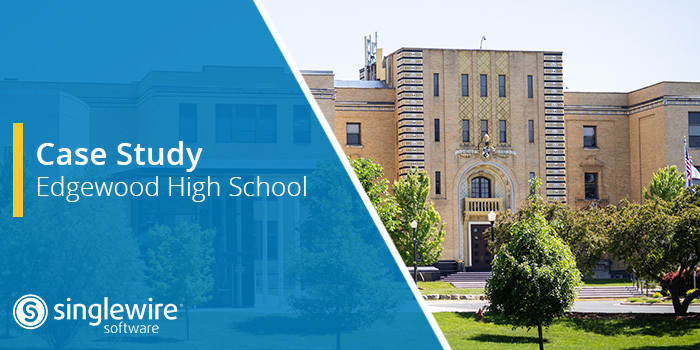
Edgewood High School of the Sacred Heart is located in Madison, Wis., and serves about 600 students and 100 faculty at its century-old campus.
The Challenge:
Edgewood High School of the Sacred Heart in Madison, Wisconsin, needed a safety strategy that worked for every member of its Dominican community. Teachers needed to know help would arrive in seconds, no matter where they were on the school’s century-old campus. The front desk needed to keep the building secure without losing its sense of welcome. Administrators needed every adult in the building to be empowered to act in a crisis.
The Solution:
Edgewood partnered with Singlewire Software to implement solutions that give every member of its community the confidence to act in a crisis, without losing the warmth that defines a Dominican education. Today, teachers feel supported in their classrooms, the front desk feels safer, and administrators know help is always one button press away.
A Mission Rooted In Relationships
Founded nearly 150 years ago by the Dominican Sisters of Sinsinawa, Edgewood High School of the Sacred Heart serves approximately 600 students and 100 faculty and staff in Madison, Wisconsin. The school is shaped by five core Dominican values: truth, justice, compassion, community, and partnership. Those values are not abstractions at Edgewood. They guide every operational decision the school makes, including how it approaches safety.
“The sisters have a great expression: relationships are the heart of ministry,” said Kevin Rea, President of Edgewood High School. “Every product and protocol we bring in is an extension of the relationship we have with our community.”
For Rea, the challenge was to strengthen the school’s safety infrastructure without losing the warmth that defines a Dominican education. As he sees it, the school has a responsibility to provide a faith-based education while still preparing students for the world as it actually is. That means addressing real-world safety alongside academic and spiritual formation.
Community engagement is a key pillar of Edgewood’s strategic plan, and the school has leaned into that pillar to inform its safety work. Local law enforcement, alumni, parents, and faculty have all had a seat at the table as Edgewood has evolved its approach.
“School safety has always been important here,” Rea said, “But we’ve taken a more purposeful approach the last several years.”
Building a Layered, Integrated Approach
A pivotal step was creating a new administrative role: Director of Facilities and Safety. Edgewood hired Tim Patton, a retired captain from the Madison Police Department and school alumnus, to lead the work. Patton brings nearly 25 years of law enforcement experience to a community he already knows well.
“We’re trying to achieve a culture of safety in everything we do,” said Patton. “It has to be a layered approach. It has to keep relationships at the center. And it has to serve the mission.”
Patton arrived to find various safety components in place that addressed specific challenges, but didn’t work well together when incidents took place. He was tasked with moving Edgewood toward a fully integrated ecosystem in which every tool, every drill, and every notification reinforced the same plan.
“We don’t have unlimited time or resources to prepare for an emergency,” Patton said. “Our systems and our training need to be seamless, aligned, and simple, so that everyone has confidence in performing their role.”
That commitment to integration is what drew Edgewood deeper into a partnership with Singlewire Software. The school had already begun using InformaCast as a critical communication platform; the question now was how to extend it across every layer of the school’s safety plan.
Putting Safety in Every Hand with the Wearable Alert Badge
The most transformative addition to Edgewood’s safety strategy is the InformaCast Wearable Alert Badge. Each staff member now wears a wireless badge, giving them a direct way to summon help. Badges can send a discreet request for help or initiate a school-wide lockdown through InformaCast.
“Any teacher is three presses away from another adult standing next to them in less than sixty seconds,” said Patton.
For Holly Guenther, a math teacher on the third floor of Edgewood’s oldest building, the badge offers reassurance. Previously, responding to a medical emergency or a classroom disruption meant finding a phone, dialing the right number, hoping someone answered, and sometimes sending a student to get help.
“The badge has really changed how I feel in the classroom,” Guenther explains. “It’s made me feel safe.”
Because the badge transmits precise location information, the closest available administrator is dispatched to the teacher. That specificity matters in a building that has multiple floors and a labyrinth of nooks and corners.
“It doesn’t matter where the admins are in the building. The closest one will come because it tells exactly where I am,” said Julie Grosse, the school’s main office assistant.
Patton, who spent his law enforcement career thinking about coordinated emergency response, sees the badge as the single most important way Edgewood has expanded its safety strategy.
“It leverages our greatest asset, our people, and empowers them to be part of the safety culture,” said Patton.
For Rea, the case for the badge comes back to what Edgewood is asking its teachers to do every day. “The ease and efficiency of the badge means they don’t have to worry about all the rest,” he said. “If there’s an issue, they just push the button several times, and they know what they’re going to get.”
Reaching Every Corner of Campus with InformaCast
The badge would not be possible without the InformaCast software that powers it. When a badge is activated, InformaCast simultaneously notifies a designated response team, updates digital signage, takes over desktop screens, sends mobile alerts, and broadcasts over the school’s paging system.
“There are probably fewer things at the school that aren’t directly tied into InformaCast,” said Ben Mund, Director of Technology at Edgewood.
Edgewood has standardized its messaging on the Standard Response Protocol from the “I Love U Guys” Foundation, so the language faculty hear in a drill matches the language they see in an alert. That consistency, Patton said, shortens the cognitive distance between recognition and response.
“InformaCast gives us the ability to customize everything,” said Mund. “I can build any button for any type of notification and really control where it goes. That was a huge improvement for us.”
A Welcoming, Secure Front Door with Visitor Aware
While the badge and InformaCast are key safety tools within the building, Edgewood’s safety plan begins at the front door. Every guest is routed through Visitor Aware where they scan their driver’s license and have their photo taken. The previous process relied on hand-typed entries on a tablet, which resulted in errors and longer wait times.
“You’d have a line of people, and sometimes the temptation then is to just let people in because it was taking too long,” Grosse said. “Now it’s quicker and much more accurate. I see a picture of who’s here, I see when they leave, and I see where they went. That’s all peace of mind.”
For Patton, Visitor Aware does what a good controlled-access plan should do: it tells parents, contractors, and community members that the school takes their safety seriously without making the building feel fortified.
“People are confident that there’s a safety plan in place when they see we’re employing Visitor Aware,” he said.
Safety That Serves the Mission
Edgewood is not finished. The school is working with Singlewire and local first responders to integrate the badge with the 911 dispatch center, so that a lockdown automatically alerts police. Mund is also exploring more notification endpoints, including connecting InformaCast with the school’s phone system.
“To have every single faculty and staff member in the building have the ability to change the status of the building, and to understand what it means and what they are to do, is a game changer,” said Patton.
From the board to faculty and parents, Rea says the response has been uniformly positive.
“It’s one of the easiest sells I’ve had to do here,” he said. “I would encourage every administrator to consider these tools, as a way to be proactive, anticipate threats, and keep their community together.”
To learn more about how your school or district can leverage Singlewire solutions, including InformaCast, the InformaCast Wearable Alert Badge, and Visitor Aware, to enhance safety and communication, visit our Schools & Districts page or schedule a personalized demo.