
Preventing a Security Collapse
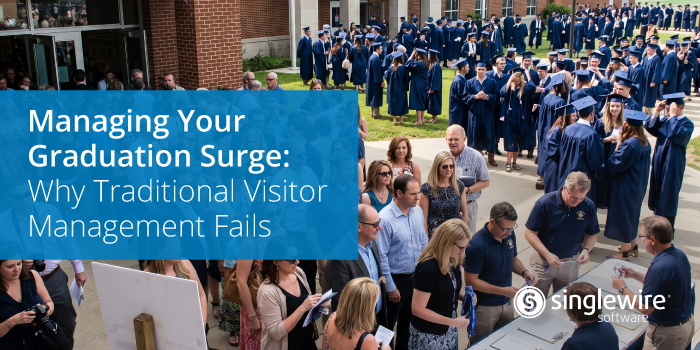
At the end of the school year, districts across the country are facing a familiar bottleneck. The graduation season brings a celebratory atmosphere, but for administrators and facilities directors, it also brings a logistical complication. During a standard school day, a front office might process a dozen visitors. During graduation, that number swells to hundreds in a single day.
The traditional methods of managing these visitors—paper sign-in sheets or a single standalone kiosk—are not just inefficient; they represent a significant point of potential failure. When a line of parents and grandparents stretches from the front desk out into the parking lot, the pressure on staff to “just let them in” becomes immense. This operational friction creates a dangerous trade-off between speed and safety, often leading to a total collapse of the district’s security protocol at the exact moment when the campus is at its most vulnerable.
The Bottleneck: Why Daily Workflows Don’t Scale
Most visitor management protocols are designed for the “steady state”—the predictable, low-volume flow of vendors and late-arriving students. These systems rely on a manual ID check and, in some cases, printing a single adhesive badge. However, this process doesn’t scale either technically or practically. When hundreds of people arrive at once, even an efficient process can be overwhelmed and begin to create delays.
This collapse has a ripple effect across the entire campus. Facilities teams find themselves managing parking lot overflows and perimeter breaches as frustrated guests look for alternative entrances. IT teams face sudden spikes in guest Wi-Fi demand that can throttle critical administrative traffic. For the building principal and district leadership, this surge transforms from a celebration into a liability event where they no longer have an accurate roster of who is on the premises.
The Security Fallacy of the “Open Door” Policy
To alleviate the visible frustration of long lines, many schools revert to a “gate-open” policy during high-traffic events. The rationale is that since it is a public event, the standard vetting process is unnecessary, but this can be a strategic error. The Duty of Care standards for K-12 institutions have evolved; “high-traffic” is no longer an acceptable excuse for failing to screen individuals against national registries or internal “no-entry” lists.
The failure to maintain a digital paper trail during graduation creates a significant accountability gap. If an incident occurs—whether it is a medical emergency in the bleachers or a confrontation between guests—leaders need to understand who is in their building. Without a scalable digital management system, the district is effectively flying blind, relying on outdated paper logs that are often illegible or incomplete.
Architecting for High-Volume Ingress
Solving this challenge requires a shift from reactive check-ins to a proactive, distributed visitor management strategy. This involves moving the check-in process away from the physical front desk and into the digital space well before the event begins. By decentralizing the authentication process, districts can maintain high security standards without creating a physical bottleneck at the door.
To successfully manage the transition from daily operations to event-level volume, administrative and IT leaders must implement workflows that prioritize speed through automation. The following capabilities are essential for ensuring that high-volume events do not compromise the security of the campus:
- Digital Pre-Registration: Allowing guests to submit their identification information via a secure portal days before the ceremony, enabling the district to screen and approve entry in batches.
- Encrypted QR Access Codes: Sending approved guests a unique, time-sensitive QR code to their mobile device, which can be scanned at multiple entry points by staff using handheld devices or mobile apps.
- Self-Service Kiosk Clusters: Deploying temporary, tablet-based stations that allow pre-approved guests to check themselves in, reducing the burden on front-office staff. Tablets are also easy to scale for large events, enabling schools to add more stations as visitor volumes increase.
- Integrated “No-Entry” Logic: Ensuring that even during a high-speed scan, the system is cross-referencing guest data against custody dispute lists and sex offender registries in real-time.
By implementing these changes, the experience moves from frustration to professional efficiency. By pre-vetting the crowd, the district ensures that the actual day-of entry is a simple “scan and go” process. This not only preserves the security of the campus but also signals to the community that the district takes its Duty of Care seriously, even—and especially—during the busiest times of the year.
From Logistics to Leadership Accountability
For school administrators, managing a high-traffic event is a test of organizational resilience. It is an opportunity to prove that the safety protocols touted during the school year are not just for show, but are robust enough to withstand extreme pressure. The transition from manual, paper-based workflows to a digital-first identity management strategy is not merely an IT upgrade; it is a strategic repositioning of the district’s security posture.
When the graduation surges are managed effectively through pre-registration and automated scanning, the result is a safer environment and a more professional institutional reputation. District leaders can provide a clear audit trail of everyone who attended, facilities teams can manage the flow of people with precision, and the focus remains where it should be: on the achievement of the students rather than the failure of the infrastructure.
Modernize Your Event Security Infrastructure
Managing the unique pressures of graduation visitors requires more than just extra staff; it requires a sophisticated, scalable technology platform. Singlewire Software offers the tools necessary to bridge the gap between daily visitor management and high-volume event security.
By utilizing Visitor Aware, school districts can implement pre-registration workflows, conduct real-time background screenings, and utilize QR-code entry to eliminate front-desk bottlenecks. When integrated with InformaCast, your visitor data becomes part of your broader safety ecosystem, ensuring that if an emergency arises, every guest on your campus can be reached with critical information. Check out our Visitor Aware page to learn more.